










If you wish to understand Russian culture beyond its iconic landmarks, time-honoured traditions, and well-known historical milestones, Russian icons offer a captivating entry point. For over a millennium, these sacred images have been interwoven with the spiritual and cultural fabric of Russia.
Icons occupy a cherished place in Russian Orthodox tradition, family heritage, and daily life. Even today, travellers to Russia can encounter icons in churches, monasteries, museums, and historic homes—each one a silent witness to centuries of devotion.
What Exactly Is a Russian Icon?
Within Orthodox tradition, an icon transcends the notion of a mere portrait of a saint or a religious painting. It serves as a symbolic bridge connecting the material and spiritual realms.
Believers traditionally pray before icons, seek assistance, and offer gratitude for life’s pivotal moments. Icons were frequently passed down through generations and carried on journeys as sources of protection. In traditional Russian homes, an icon often occupied a place of honour known as the “red corner” (красный угол).
The Sacred Craft of Icon Painting
Traditional Russian icon painters, called iconographers, adhered to established religious canons. They worked with prescribed images, gestures, compositions, and colours. Unlike conventional realistic art, icons were never intended to depict people exactly as they appear in everyday life.
Creating an icon was regarded as a spiritual discipline as much as an artistic endeavour. An iconographer was expected to approach the work with a particular mindset, often accompanied by prayer.
This helps explain why icons differ so profoundly from Western-style portraits and paintings. Their purpose was not merely to produce a beautiful image but to communicate spiritual truth.


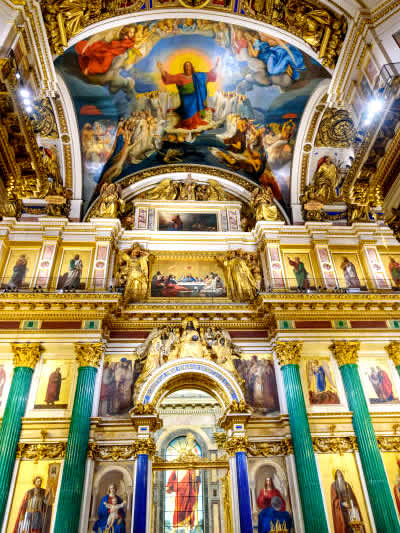

Why Icons Matter for Travellers
For those intrigued by Russian culture, encountering an icon in its original historical context can transform a trip into a deeply meaningful experience. Museums and ancient churches provide opportunities not only to admire the artistry but also to learn about the traditions and beliefs that shaped Russian history.
If you are planning to visit Russia, exploring subjects such as Russian icons, Orthodox traditions, and the “red corner” can help you understand the country beyond its language and tourist attractions.
And if you are studying Russian, you may well encounter these cultural concepts in literature, history, and everyday conversation. Learning Russian is not merely about grammar and vocabulary—it is also a pathway to discovering Russian culture from within.
Key points
What is a Russian icon, and why is it more than just a painting?
A Russian icon is a sacred image used in Orthodox prayer and worship. It is understood not as a realistic portrait, but as a symbolic window connecting the physical and spiritual worlds . Its primary purpose is to convey spiritual truth and serve as an object of veneration, rather than to be admired as a piece of art.
What is the "Red Corner" in a traditional Russian home?
The "Red Corner" (Красный угол) is a sacred space traditionally located in the eastern corner of a Russian home. It serves as a domestic altar, where icons—often of Christ and the Virgin Mary—are placed on a shelf or in a small iconostasis . Families would pray before these icons, and it was considered the most honorable part of the home, used to bless important events like a son leaving for military service.
How were Russian icons created, and what makes the technique unique?
Traditional icons are created by "iconographers" through a deeply spiritual process. The technique typically involves painting with egg tempera on a wooden panel prepared with a gesso ground (levkas) . The style is distinctive for its use of inverse perspective (where lines converge behind the image, not in front of it), symbolic colors, and a flat, non-realistic aesthetic that directs the viewer's attention from the physical world to the spiritual one.
What is the main difference between Russian icons and Western religious paintings?
The fundamental difference lies in their purpose and style. Western religious art often aims for realism, emotional expression, and aesthetic beauty, depicting saints as they might appear in everyday life. In contrast, a Russian icon is a liturgical object meant for prayer. It uses a stylized, symbolic language—such as elongated figures and specific gestures—to portray a transfigured, spiritual reality rather than physical likeness . One Orthodox explanation notes that icons are "light-created," emphasizing divine light, while Western painting is "shadow-created," emphasizing human emotion and form .
Who is the most famous Russian iconographer, and what is his legacy?
The most celebrated figure is Andrei Rublev (c. 1360–1430), a monk and icon painter later canonized as a saint. His work, especially the famous Trinity icon, is considered the pinnacle of Russian iconography. For centuries after his death, his style became the ideal model that other iconographers were instructed to follow, representing a perfect union of artistic mastery and spiritual devotion.
Read also: Russian classic literature: what to read


