










Bright red berries, golden leaves, and a black background — this is how most people picture Khokhloma painting. This folk art form is one of Russia’s most recognizable symbols and has been delighting people around the world for over 350 years.
Khokhloma painting originated in the second half of the 17th century in the Volga River region, on the left bank of the river in what is now the Koverninsky District of Nizhny Novgorod Oblast. Winters there were long and the soil poor, making farming difficult, so local people turned to the vast forests for woodworking and painting. Old Believers fleeing religious persecution settled in the area, and among them were icon painters who brought with them the technique of imitating gilding using tin powder. In 1659, a letter from the nobleman Morozov mentioned “painted dishes coated with tin” — one of the earliest written records of what would become Khokhloma.
Interestingly, the name “Khokhloma” does not come from the place of production but from a trading village of the same name. Craftsmen brought their finished wooden wares there for sale, and merchants then shipped them along the Volga to the Makaryev Fair and even as far as Persia, India, and Western Europe.
Despite the abundance of gold in the designs, no real gold was ever used. Craftsmen usually choose linden, aspen, or birch, and turn bowls, spoons, and jars on a lathe to create what is called “white ware.” The white ware is first coated with a clay and linseed oil primer, then repeatedly rubbed with linseed oil. After that, aluminum powder — tin powder in earlier times — is applied by hand, giving the surface a silver, mirror-like sheen. The painter then uses squirrel-hair brushes and oil paints to freely draw plant motifs, mainly in black and red. The painted object is coated with several layers of lacquer and finally fired in an oven at about 150–160°C. Under the heat, the lacquer film turns golden — this is the origin of Khokhloma’s famous “gold.”
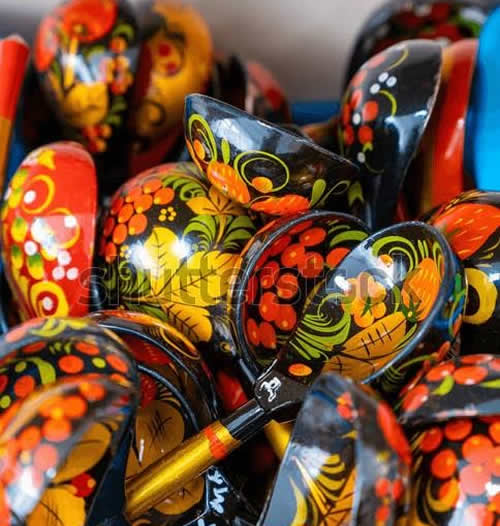
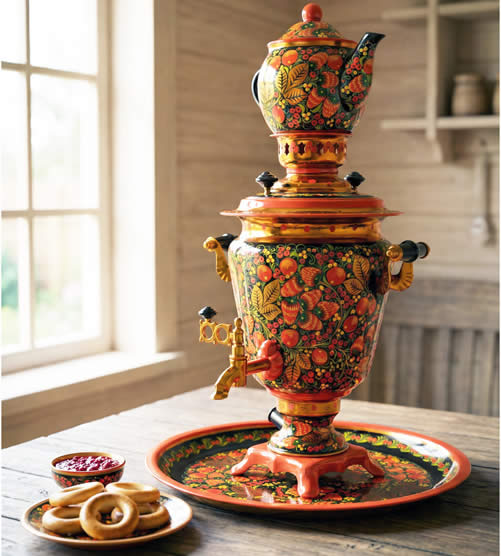
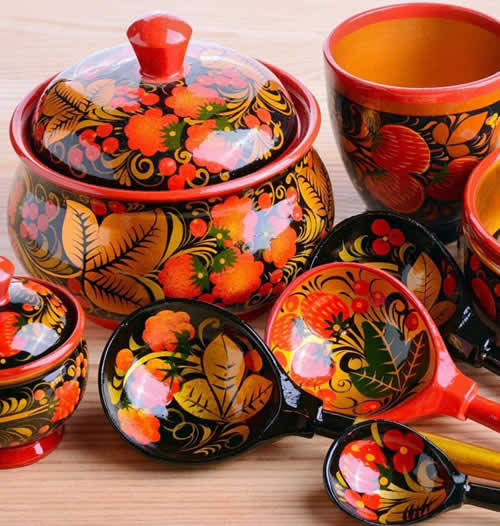
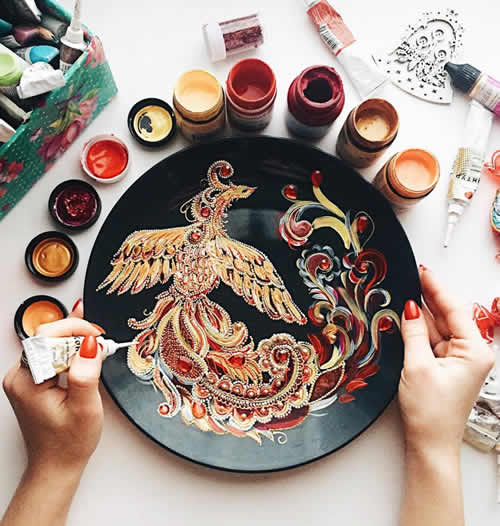

The main elements of Khokhloma painting are rowan branches, wild strawberries, leaves, flowers, and scrollwork — all stylized rather than realistic, which is part of what makes the style so distinctive. There are two main approaches. In “top painting,” light grasses, berries, and curling tendrils are painted in red and black on a golden background, giving a translucent, airy feel. In “background painting,” the background is first filled with black or a color, leaving the golden ornament in relief, which produces a stronger, heavier visual effect. Each design is created entirely by hand, so no two pieces are exactly alike.
Originally, this style of painting was used to decorate wooden spoons, bowls, plates, and furniture. Today, Khokhloma patterns can be seen not only on souvenirs but also in contemporary design, clothing, home furnishings, and even sports equipment — Russian Olympic uniforms, for example, have featured Khokhloma-inspired prints. During the Soviet period, scattered craftsmen were organized into cooperatives, and the craft was systematically restored and passed on. Today it is concentrated mainly in two centers in Nizhny Novgorod Oblast: the city of Semyonov and the village of Semino. Painters in Semyonov favor intricate background painting, while craftsmen in Semino preserve a lighter, more graceful grass-and-leaf style.
For foreigners, Khokhloma offers an opportunity to discover Russian folk traditions through art. Each piece tells a story of nature, craftsmanship, and a love of beauty, passed down from generation to generation. As one craftsman put it, the value of Khokhloma lies in “handwork, unique technique, and the people who keep this craft alive.”
If you ever find yourself traveling around Russia, be sure to look out for items featuring Khokhloma painting. It is one of the most beautiful and memorable souvenirs, preserving a piece of Russian culture and centuries-old traditions.
Key points
Why is it called Khokhloma?
Most people assume it's named after the place it was invented. In reality, Khokhloma is named after a trading village called Khokhloma, where craftsmen brought their goods to sell. The painting style actually originated in dozens of villages around the Koverninsky District of the Nizhny Novgorod region. Merchants would buy the wares at the Khokhloma market and ship them down the Volga River, so the name stuck.
Does Khokhloma use real gold?
No. This is the single most surprising fact for foreigners. The "gold" is an illusion created through a clever chemical process. Craftsmen coat the wood with aluminum powder (historically tin powder), paint it with oil colors, cover it in lacquer, and then fire it in an oven at about 150–160°C. The heat turns the lacquer golden, creating the famous shine without any precious metal
What is the difference between "top painting" and "background painting"?
There are two main styles. Top painting means you paint the red and black floral patterns directly onto a golden background. Background painting is the opposite: you outline the design, then fill in the background with black, leaving the ornament itself in golden silhouette. The most dramatic version of background painting is called Kudrina, where golden curls swirl like waves against the black.
Who invented Khokhloma?
The technique is credited to Old Believers—religious refugees who fled persecution in the 17th century. Among them were icon painters who knew the secret of "gilding" wood cheaply using tin powder. They brought this technique to the Trans-Volga forests, where local craftsmen already had strong woodturning traditions. The barren land forced people to find winter work, and the two skills merged into what we now call Khokhloma
Where can I buy authentic Khokhloma today?
The two main production centers are the city of Semyonov and the village of Semino in Nizhny Novgorod Oblast. For tourists, the easiest places are the Department Store RUSSIA in Moscow, or the new Khokhloma brand shop-workshop in Plyos. Modern collaborations—like silk scarves made with designer Alena Akhmadullina—are also bringing Khokhloma into contemporary fashion.
Read also: Russian Icons


