










Russian mythology is a whole world that has shaped the worldview of the Eastern Slavs for centuries, their attitude to nature, fate, and the invisible. Today, interest in these origins is growing again: Russian paganism is seeking a connection with its roots, restoring lost names and meanings.
 Slavic pantheon: gods of fire, sun, and thunder
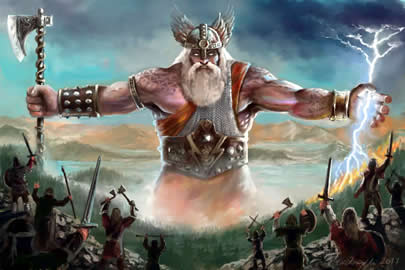 Slavic pantheon: gods of fire, sun, and thunder
Although almost no written sources have survived, archaeology, chronicles, and folklore allow us to reconstruct the image of the Slavic gods.
– Perun (Перун) was the god of thunder and military valor. He was feared and respected: weapons were considered sacred, and oaths sworn on swords had special power.
– Veles (Велес) was his opposite, the lord of the underworld, livestock, and wealth. The thin line between life and death passed through him.
– Mokosh (Мокошь) was the protector of women, fate, and handicrafts. Her image later became intertwined with the Christian Paraskeva Pyatnitsa.
– Yarilo (Ярило) was the young god of spring and fertility, the embodiment of the renewal of nature, celebrated in rituals associated with the solar cycle.
Interestingly, many features of these gods were preserved in folk customs even after the baptism of Rus in the 10th century, which speaks to the depth of pagan roots.
 The world of spirits: between home and wilderness
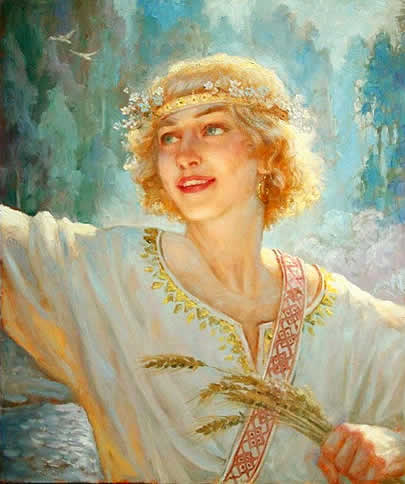 The world of spirits: between home and wilderness
The Slavs believed that every object and place had its own guardian. Therefore, mythology includes not only gods, but also spirits that lived alongside humans.
– Domovoy was the guardian of the home. He was respected, but could also be appeased with a saucer of porridge or a piece of bread
– Leshy was the lord of the forest, who could knock a traveler off the road or, conversely, lead them home if he was favorably disposed toward them.
– Kikimora was a female spirit of disorder at night: if a woman did not manage her household well, Kikimora would “send a sign.”
– Mermaids were not always beautiful girls from fairy tales. In ancient beliefs, they were dangerous water spirits associated with nature worship and sacrifices.
These characters show that the ancient Slavs did not divide the world into “good” and “evil” — everything was a matter of balance and respect.
Russian paganism today: a return to the roots
Modern Rodnoverie (Russian paganism) is an attempt to restore pre-Christian traditions, rituals, and worldviews. It includes:
- celebrating the Slavic calendar cycle (Kupala, Kolyada, Gromnitsa);
- reconstruction of the cults of Perun, Veles, and other gods;
- veneration of ancestors and nature as a living force.
It is important to understand that modern Rodnoverie is not an exact copy of the ancient faith, but a reinterpretation based on folklore, archaeology, and cultural memory.
Why Russian mythology is relevant again
Interest in mythology is growing for good reason:
- it helps us understand our cultural roots and identity;
- it reveals a forgotten layer of folk wisdom;
- it inspires contemporary art, from literature to video games.
Russian mythology is not a thing of the past, but a living system of images that continues to influence our perception of the world.
Key points
What mythology does Russia have?
Russia is rooted in Slavic mythology, which includes ancient gods, nature spirits, and folk beliefs of the Eastern Slavs. It later blended with Finno-Ugric and Christian traditions, forming a unique cultural mix.
What is Russian paganism called?
Russian paganism is commonly called Slavic paganism, and in modern form it’s known as Rodnovery (“Native Faith”). It focuses on the worship of traditional Slavic deities and reverence for ancestors and nature.
Is paganism still practiced in Russia?
Yes, modern Slavic paganism is still practiced in Russia by small communities and cultural groups. It remains a minority belief system, mostly focused on reconstruction of traditions rather than continuous ancient worship.
Read also: Russian fairy tales


