










Russian folk music has ancient roots that go back more than a thousand years. Long before Russia became a single state, people in villages sang songs to accompany every part of life — planting, harvesting, weddings, and celebrations. Music was a way to express emotions, tell stories, and unite communities.
Many of these songs were passed down orally from generation to generation. The lyrics often described nature, love, and the struggle of everyday life. Through them, you can hear the Russian soul — deep, emotional, and sincere.
Learning Russian helps to appreciate these songs even more. When you understand words like воля (freedom) or тоска (melancholy), you begin to feel their true meaning — something that cannot be fully translated.
Traditional Instruments: From Balalaika to Gusli
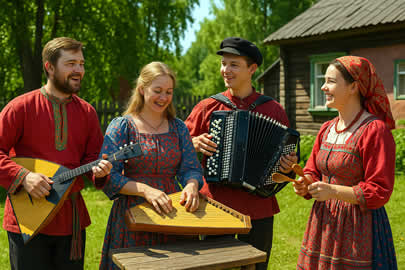 Russian folk instruments are as diverse as the country itself. The balalaika — with its triangular body and three strings — is perhaps the most iconic. Its cheerful sound can make anyone smile. The domra, another string instrument, has a softer, lyrical tone.
The gusli, one of the oldest instruments in Eastern Europe, was played by wandering storytellers called skomorokhi. They traveled from town to town, entertaining people with music and satire.
The accordion (or bayan) later became a favorite at village festivals, bringing energy and rhythm to dances.
Each instrument reflects the Russian character — a mix of sadness and joy, simplicity and depth.
The Birth of Folk Dances
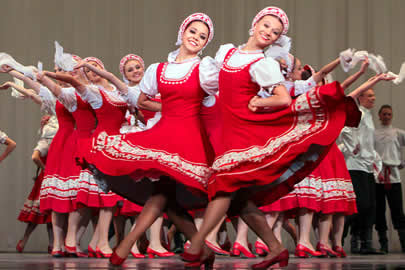 Folk dances in Russia grew naturally from the rhythms of daily life. Farmers celebrated good harvests with circle dances, soldiers performed strong and proud movements, and couples danced playful routines at weddings.
The famous Barynya, for example, combines fast steps, clapping, and humor. The Kazachok, originating from the Cossacks, is full of athletic jumps and kicks. And of course, the Kalinka — a symbol of Russian joy — invites everyone to join in.
These dances are not just performances; they are collective expressions of spirit and togetherness.
Costumes and Symbolism
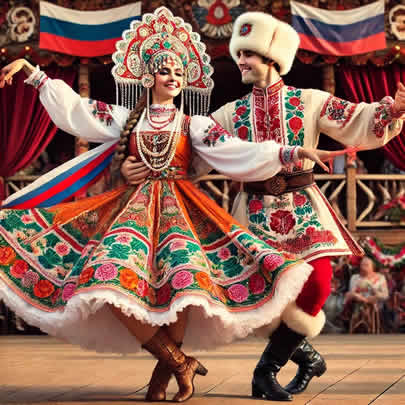 Vibrant traditional costumes are the very soul of Russian folk culture. The women’s attire is a spectacle of color and layer: embroidered blouses, bright sarafan dresses or checkered ponyova skirts, all crowned by the iconic kokoshnik headdress, which sparkles with pearl and gold thread like a regal diadem.
The men’s costume, consisting of a kosovorotka shirt, a red sash, and tall boots, appears more restrained but is full of grounded strength and readiness for dynamic dance. Every color and pattern in these garments carries deep meaning, turning the costume into a coded language. Red symbolizes beauty, love, and vital energy; blue and white represent peace and spiritual purity; green is the color of nature and renewal.
The intricate embroidery often features ancient solar signs, roosters, horses, and geometric patterns, each serving as a charm or a wish for prosperity and protection. Together with spirited music, these costumes transform folk performances into a vivid, moving celebration.
The whirl of skirts, the flash of red sashes, and the shimmer of headdresses become an extension of the melody, creating a powerful expression of life, familial continuity, and communal unity. This living art form connects the present to the past in a dazzling display of national identity.
Why Learning Russian Brings It All Closer
Understanding the Russian language opens the door to the world behind the melodies. You can sing along, understand the jokes in old songs, and connect with people more deeply. The word душа (soul) appears in countless Russian folk lyrics — because, in Russia, art is always about the soul.
So, if you love music, travel, and authentic culture, come and experience it yourself. Visit a village festival, dance with locals, and feel how music unites people across borders.
Key points
What is the traditional dance of Russia?
One of the most famous traditional dances of Russia is the Barynya, known for its lively steps, fast tempo, and playful spirit. It represents the joy and energy of Russian village celebrations.
What is the most popular Russian folk song?
The song “Kalinka” is the most well-known Russian folk tune, loved around the world for its catchy rhythm and joyful melody. Its lyrics celebrate nature and love, capturing the bright spirit of Russian folklore.
What is the traditional instrument of Russia?
The balalaika is considered the traditional instrument of Russia, easily recognized by its triangular shape and three strings. Its cheerful sound has become a symbol of Russian folk music and culture.
Read also: Traditional Russian clothing


