










Since the early days of the ISS, Russian scientists have led a broad spectrum of medico-biological studies. Their goal is to understand how microgravity, radiation, and the isolation of space affect human health and physiology. According to a report from the Russian segment’s science program, over 20 years, more than 57 biomedical experiments have been completed.
Some of these studies focus on:
- The “Matryoshka-R” experiment, which uses a human-torso mannequin to measure how cosmic radiation penetrates different layers of tissue inside a human-like structure.
- Long-term monitoring of crew health: studying sleep patterns, cardiovascular function, immune responses, and other vital systems in microgravity.
These insights are crucial not only for the safety of astronauts but also for preparing for future long-duration missions, including deep-space travel.
Breakthroughs in Physics and Material Science
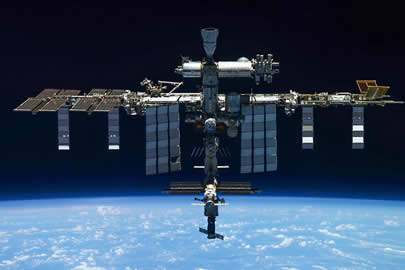
Russian researchers use the ISS not just for life sciences — they also run advanced physical-science experiments, especially in the newer Nauka (“Science”) module.
 Some highlights:
– Impuls (Impulse) Plasma Injector – IPI-500: During a recent spacewalk, cosmonauts Sergey Ryzhikov and Alexey Zubritsky installed the IPI-500 on the Nauka module. This device is designed to study how plasma jets affect the Earth’s ionosphere — a topic relevant for understanding space weather and how satellites interact with our upper atmosphere.
– Molecular Beam Epitaxy (“Ekran-M”): Also installed during that spacewalk, this apparatus enables the creation of ultra-thin crystalline films directly in space. These materials have potential applications in next-generation semiconductors and other high-tech devices.
– Multi-zone Electric Furnace: In the Nauka module, this furnace allows researchers to heat materials under precise conditions in microgravity, enabling experiments that are impossible on Earth. Astrophysics and Radiation Research
Beyond biology and materials science, Russian scientists have contributed to astrophysical research on the ISS:
 – Mini-EUSO Telescope: Installed in the Russian module, this ultraviolet telescope scans Earth’s atmosphere. It observes phenomena like meteors, transient luminous events, and even searches for unusual matter like strange quark matter.
– Submillimetron Project: A proposed submillimeter telescope concept that would dock with the ISS, using a cooled 60 cm mirror to observe in very low-frequency bands. Though ambitious, the project shows the long-term vision in leveraging the station for cutting-edge observations.
– Operational and Technological Contributions: Breakthroughs in life support systems, medical research, robotics, commercial manufacturing, and long-term health and environmental monitoring research.
Russian cosmonauts also play a key role in maintaining and upgrading the ISS infrastructure, which in itself supports future science:
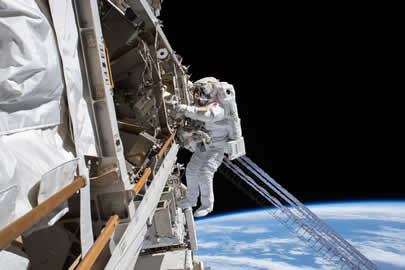
- Spacewalks: In October 2025, Ryzhikov and Zubritsky carried out a ~6.5-hour EVA (extravehicular activity), installing experimental hardware, cleaning module windows, and conducting critical maintenance.
- AI Integration: In a more futuristic development, Russia is planning to deploy its homegrown AI model (Gigachat) on the ISS. According to Roscosmos leadership, this system will help cosmonauts analyze satellite imagery and process data directly on board.
Why It Matters
The work done by Russian researchers on the ISS is not just “space science” — it has real-world relevance:
- Human Health: Understanding how radiation and microgravity affect the human body helps prepare for long-term missions (e.g., to Mars).
- Advanced Materials: Microgravity enables the creation of materials with properties not achievable on Earth, with applications in electronics, optics, and more.
- Earth Observation & Space Weather: Studying the ionosphere and plasma interactions helps us better predict space weather and its impact on satellites and communication.
- Astrophysics: Instruments like Mini-EUSO deepen our understanding of cosmic phenomena.
Key points
What does the ISS stand for?
ISS is a modular space facility located in low Earth orbit and serves as a research laboratory. The ISS is a joint project of several space agencies: NASA (United States), Roscosmos (Russia), JAXA (Japan), ESA (Europe) and CSA (Canada).
What is Roscosmos?
Roscosmos is the Russian state corporation that manages Russia's space industry, including its space exploration, satellite systems, and human spaceflight programs. It was established in 1992 after the dissolution of the Soviet Union and is headquartered in Moscow.
When can I see ISS?
The ISS is visible because it reflects sunlight, appearing as a bright, fast-moving white dot in the sky, typically just after sunset or just before sunrise. It is often the brightest object in the night sky besides the Moon and no special equipment is needed to see it.
Read also: Essential Tips for Visiting Russia


