










In the mid-20th century, humanity experienced its most profound metamorphosis: the transition from a species tied to its planetary cradle to a species capable of extending into the cosmic ocean. This transformation is bookmarked by two seminal events, separated by less than four years, that forever altered our self-perception and ambition. The launch of the first artificial satellite, Sputnik 1, and the flight of the first human, Yuri Gagarin, were more than just technical triumphs; they marked the opening chords of a symphony of space exploration.
The First Echo: Sputnik 1 and the Shock of the Possible
Before the evening of October 4, 1957, the concept of an artificial moon was the stuff of speculative fiction. On that date, from the desolate steppes of the Kazakh Soviet Socialist Republic, a modified R-7 intercontinental ballistic missile hurled a 58-centimeter polished metal sphere into the void.
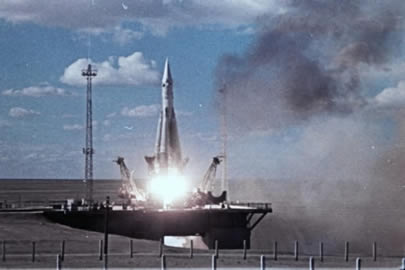 Christened Sputnik 1 (Russian for “traveling companion” or “satellite”), this unassuming object, with its four trailing whip-like antennas, became the first human-made artifact to achieve Earth orbit.
Sputnik’s scientific payload was simple: two radio transmitters emitting a steady “beep-beep-beep” signal on frequencies amateur operators worldwide could detect. This iconic sound was a sonic revolution, a tangible proof of concept that reverberated across the globe.
Its implications were immediate and seismic. Politically, it triggered the “Sputnik Crisis” in the United States, galvanizing public investment in science, technology, and education, and intensifying the Cold War space race.
Scientifically, it provided the first data on the density of the upper atmosphere and demonstrated the viability of radio communication from orbit. Most importantly, it shattered a psychological barrier. By placing an object in the cosmic realm, humanity had taken its first, irrevocable step off the planet, proving that space was not an impenetrable fortress.
The First Witness: Yuri Gagarin and the Humanization of Space.
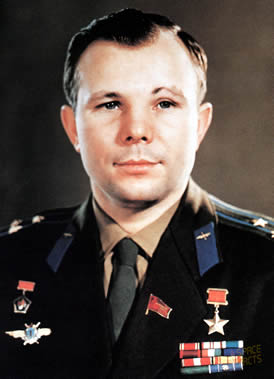 If Sputnik marked humanity’s mechanical entry into space, then Major Yuri Alekseyevich Gagarin embodied its human spirit. On April 12, 1961, Gagarin launched aboard the Vostok 1 spacecraft from the same remote airfield now known as the Baikonur Cosmodrome.
In a compact spherical descent module attached to the instrument module, he completed a single 108-minute orbit of the Earth, reaching a maximum altitude of 327 kilometers.
Gagarin’s mission, codenamed “Kedr” (Cedar), was a model of astonishing brevity and enormous risk. The flight was fully automated; a secret override code was provided in an envelope in case of emergency, but he exercised no manual control.
His transmissions, particularly the remark “The Earth is blue… How wonderful. It is amazing,” provided the first human perspective on our planet as a fragile, isolated celestial body.
This observation subsequently spurred the environmental awareness movement. His safe return—ejecting at an altitude of 7 km and landing by parachute separately from the capsule—confirmed that humans can survive launch, weightlessness, and atmospheric reentry.
The worldwide reaction to Gagarin’s escape was universal, awe-inspiring, and transcending political blocs.
He became an instant international symbol of courage and progress. His journey humanized the vast, impersonal void Sputnik had first breached. Space was no longer just a domain for machines and instruments; it was now a place for human explorers.
A Dual Legacy: Foundations of a New Epoch
 These two milestones form an indispensable, complementary foundation.
Sputnik 1 was the catalyst. It was a geopolitical shock, a scientific probe, and an engineering pathfinder. It proved the essential technology of orbital velocity and initiated the infrastructure of spaceflight.
Vostok 1 with Gagarin was the fulfillment. It answered the most urgent question posed by Sputnik: “If a satellite can go, can a person follow?” It proved human physiology and psychology could adapt, at least briefly, to the space environment.
Together, they established the core paradigm of modern space exploration: robotic pioneers scout the way, followed by human pioneers.
This sequence has defined missions from the Apollo lunar landings to the operation of the International Space Station and plans for Mars.
Conclusion: The Indelible Imprint
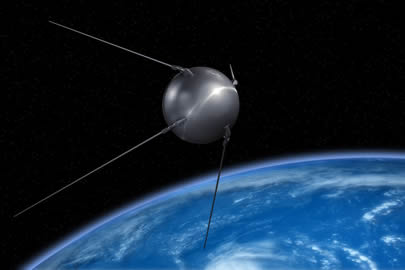 The polished sphere of Sputnik and the smiling visage of Gagarin are more than historical footnotes. They represent the dual nature of our quest: the relentless drive of our technology and the irrepressible curiosity of our spirit.
One provided the key to the gate; the other walked through it. Their achievements, occurring in the span of a mere 1,281 days, launched an era that continues to expand our knowledge, challenge our capabilities, and inspire generations to look upward and wonder what the next frontier may be.
The beep from the sky and the voice from orbit remain timeless reminders that on a quiet autumn night in 1957 and a clear spring morning in 1961, humanity, for the first time, began to truly come of age in the universe.
Key points
Who was really the first person in space, and is there any controversy?
The internationally recognized first human in space is Soviet cosmonaut Yuri Gagarin, who completed a full orbit of Earth on April 12, 1961, aboard Vostok 1. However, during the secretive Cold War space race, rumors and conspiracy theories emerged suggesting earlier, failed Soviet missions with lost cosmonauts. These stories have been thoroughly investigated by historians and space agencies and are universally dismissed as myth. The lack of credible evidence, such as official telemetry data, verified voice recordings, or named individuals with corroborating backgrounds, confirms Gagarin's primacy. The "controversy" is largely a product of the era's intense secrecy, which bred speculation, but it does not hold up to historical scrutiny.
Is Sputnik 1 still in space?
No, Sputnik 1 is no longer in orbit. While its launch marked the beginning of the space age, its journey was relatively short-lived. The small satellite, with no propulsion system of its own, was constantly slowed by friction with the extremely thin particles of Earth's upper atmosphere. After 92 days in space and approximately 1,440 orbits, Sputnik 1's orbit decayed. On January 4, 1958, it re-entered Earth's atmosphere and was incinerated by the intense heat of re-entry. Any surviving fragments would have fallen into the Pacific Ocean. Its legacy, however, remains permanently etched in history, orbiting the planet of human achievement.
How did Yuri Gagarin die?
Yuri Gagarin died in a plane crash on March 27, 1968, at the age of 34. He was conducting a routine training flight in a MiG-15UTI fighter jet near the town of Kirzhach, with flight instructor Vladimir Seryogin. The exact cause of the crash remains a subject of official inquiry and some debate. A 2011 declassified report suggested that another, larger Su-15 jet flying dangerously close may have passed Gagarin's plane, throwing it into a violent spin from which he could not recover. Other theories include poor weather conditions or a cabin pressurization issue. His death was a monumental tragedy for the Soviet Union and the world, cutting short the life of a global hero and experienced pilot who was actively preparing for a return to spaceflight.
What was the purpose of Sputnik 1?
While Sputnik 1's immense symbolic and political impact was undeniable, describing it as just a stunt overlooks its genuine scientific and engineering objectives. Its primary technical purposes were:
- To prove orbital launch capability: The mission successfully tested the R-7 rocket's ability to place a payload into Earth orbit.
- To gather atmospheric data: By measuring the satellite's radio signal and orbital changes, scientists could calculate the density of the upper atmosphere, which was poorly understood at the time.
- To study radio wave propagation: Its simple radio transmitters provided data on how signals behaved through the ionosphere.
Read also: The most famous Russian scientists


